
Jefferson County Court Records After a Jail Arrest
After a Jefferson County arrest, a person is booked into the county jail, but the court record does not exist yet. It opens when the State's Attorney reviews the arrest and files charges. At that point a case number is created and the charges become the formal court record. The jail side tells you whether someone is in custody. The court side tells you what they are actually charged with and what the court has done about it. These are different systems run by different offices.
For the custody and booking side, the jail inmate records page covers the roster and how booking works, and the jail mugshots page covers booking photos. This page stays on the court side: the charges the prosecutor filed, the case status, bond, warrants, and how to clear a record after an arrest. The booking charge that an officer lists is only a starting point, and it can differ from what finally appears in the court record.
The full path runs in a clear order: arrest, then booking at the jail, then a first appearance before a judge, then the prosecutor's charging decision, and finally the open court case that becomes the record. Each step is handled by a different actor, from the arresting officer to the State's Attorney to the Circuit Clerk. A court search works best once enough time has passed for the first appearance and the filing to happen, since an arrest does not produce a searchable case the same day.
How to Find Jefferson County Court Records After an Arrest
Jefferson County criminal cases are filed with the Circuit Clerk and posted online through Judici, the case portal that the Illinois Courts directory and the Circuit Clerk both link as the county's online records. Charges, hearing dates, and charge status appear in the case record, while arrest and booking detail stay on the jail side. The welcome portal for the county is shown below.
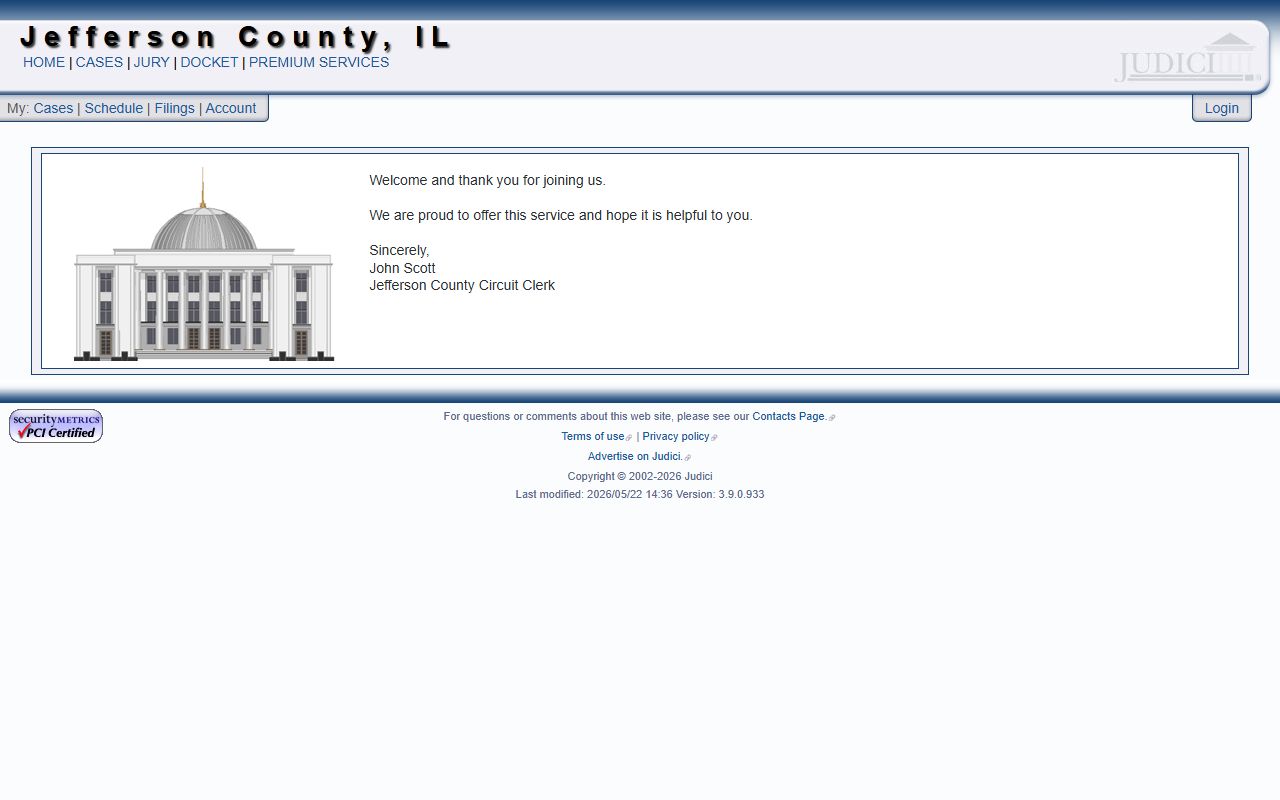
The Judici county page above is the official-linked entry point, so a court-records search after an arrest usually starts there.
- Open the Judici Jefferson County portal.
- Choose case search and enter the defendant name or case number.
- Open the case and read the list of filed charges.
- Check each charge for its code, level, and current status.
Judici uses a captcha gate on its search pages, so automated lookups can be blocked. If the case does not appear or the portal blocks you, contact the Jefferson County Circuit Clerk at 618-244-8007 or 618-244-8008 with the name and approximate arrest date.
How Charges Get Filed After an Arrest: Complaint, Information, and Indictment
The court record starts with a charging document. After booking, the case does not become real until a prosecutor or grand jury files one of three documents. Under 725 ILCS 5/111-2, an Illinois criminal prosecution proceeds by indictment, information, or complaint depending on the charge and procedure. The Jefferson County State's Attorney is the office that turns an arrest into formal charges where the evidence supports it.
| Complaint | Information | Indictment | |
|---|---|---|---|
| Filed By | Officer / Prosecutor | Prosecutor | Grand Jury |
| Common For | Misdemeanors | Many felonies | Serious felonies |
| Starts | The case | The case | The case |
The State's Attorney page reports the office files roughly 400 felony, 200 misdemeanor, 100 juvenile, and 2,000 traffic cases a year, which is the local volume that moves arrests into court records.
Charge Status and What It Means
Charges change as a case moves. A prosecutor may amend, reduce, add, or drop a charge, and a court may dismiss one. This is why the booking charge on the jail side often differs from the charges in the court record. The status terms below appear in Illinois court records, and reading them correctly prevents wrong conclusions about a case.
| Status | What It Means |
|---|---|
| Pending | The charge or case has not been resolved yet. |
| Amended / Reduced | The prosecutor or court changed or lowered the charge. |
| Dismissed | The charge ended without a conviction. |
| Nolle Prosequi | The prosecutor declined to proceed on the charge. |
Note: a charge listed in a court record is an accusation, not proof of guilt, and it stays pending until the court enters a disposition.
Bond and Release After an Arrest
Release in new Illinois cases is decided by the court, not by paying a fixed bail. Since the Pretrial Fairness Act took effect on September 18, 2023, money bail is no longer the normal release condition. Under 725 ILCS 5/110-5 and 725 ILCS 5/110-6.1, the court sets the least restrictive conditions needed and may order detention only after a specific petition and findings. The Jefferson County jail still publishes a local bonding page with fees, which can apply to older cases, warrants, or out-of-county holds.
| Item | How It Works |
|---|---|
| Pretrial release | Court sets conditions for appearance and safety in new cases. |
| Detention hearing | The State petitions to hold a person before trial. |
| Local jail fees | $25 booking fee and $11 bonding fee where a bond applies. |
| No-release hold | A detainer for another agency can keep someone in custody. |
The jail bonding page also lists a $75 fee tied to failure-to-appear charges and accepts cash, credit cards with fees, money orders, and property bonds, but not personal checks.
Warrants That Lead to an Arrest
Many arrests start with a warrant, often for a failure to appear or a probation issue. Jefferson County does not publish a searchable public warrant database, so there is no online list to confirm an active warrant. The sheriff does run an official Most Wanted feed with photos and warrant notices, but it is not a complete or searchable warrant list and should not be treated as one. For warrant questions, call the sheriff at 618-244-8004, check the court case in Judici for warrant-related activity, or contact the Circuit Clerk. Resolving a warrant usually requires a court appearance or an attorney, not a website.
Charges vs. Convictions
Being arrested and charged is not the same as being convicted. A charge is an accusation that opens a court record. A conviction is the result after a plea or a verdict. Both can appear in public court records, so a careful reader checks the disposition before drawing any conclusion.
| Charge | Conviction | |
|---|---|---|
| Stage | Accusation | Verdict or plea |
| Burden of Proof | Probable cause | Beyond reasonable doubt |
| Public Record | Yes | Yes |
Sealed vs. Expunged Arrest Records
Illinois lets people clear some arrest and court records after a dismissal or an eligible disposition. Under 20 ILCS 2630/5.2, eligible records may be sealed or expunged, with exceptions that still allow access by courts, prosecutors, and law enforcement. Sealing hides a record from most public view, while expungement removes or destroys it. Eligibility depends on the charge and outcome.
| Sealed | Expunged | |
|---|---|---|
| Visibility | Hidden from public | Destroyed or treated as never existed |
| Law Enforcement | Limited access | Very limited |
| Eligibility | Many convictions after a waiting period | Arrests without conviction and some dispositions |
Background Check Considerations
Court records found through a public portal are not the same as a regulated background check. A formal background check for hiring, housing, or credit must follow the federal Fair Credit Reporting Act and use a licensed agency. A casual lookup of court records after an arrest does not meet that standard and should not be used to make those decisions.
Important: This site is not a consumer reporting agency under the FCRA, and its information cannot be used for credit, employment, tenant, or insurance screening.
Restricted Court Records After an Arrest in Jefferson County
Not every court record after an arrest is open to the public. Juvenile cases are restricted, sealed or expunged charges are removed from public view, and records tied to an active investigation can be withheld under Illinois FOIA exemptions in 5 ILCS 140/7. The Illinois Supreme Court remote-access policy also separates courthouse access from online access, so some documents that exist in the file may not be available remotely. When a case cannot be found online, the courthouse records counter or the Circuit Clerk is the next step, and the State's Attorney handles prosecution questions rather than legal advice.
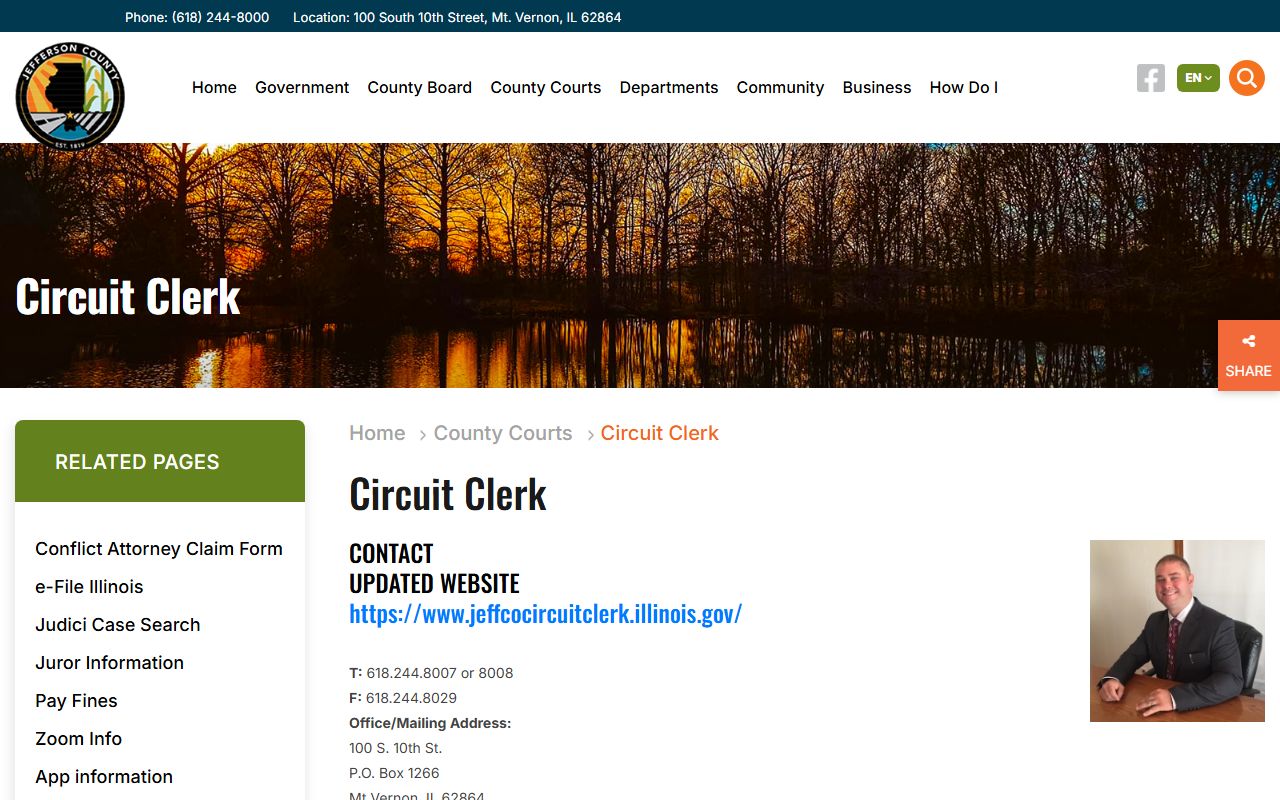
The Circuit Clerk page above lists the office duties and contacts that handle case files when an online search cannot complete.